Why Academic Friends Make Terrible Manuscript Reviewers
Your academic friends are brilliant, and that's the problem. Each one reads your manuscript through their own training and pet peeves, leaving you confused, frazzled, and pulled in five directions. Here's what a developmental editor does differently.
 Laura Vasquez Bass, PhD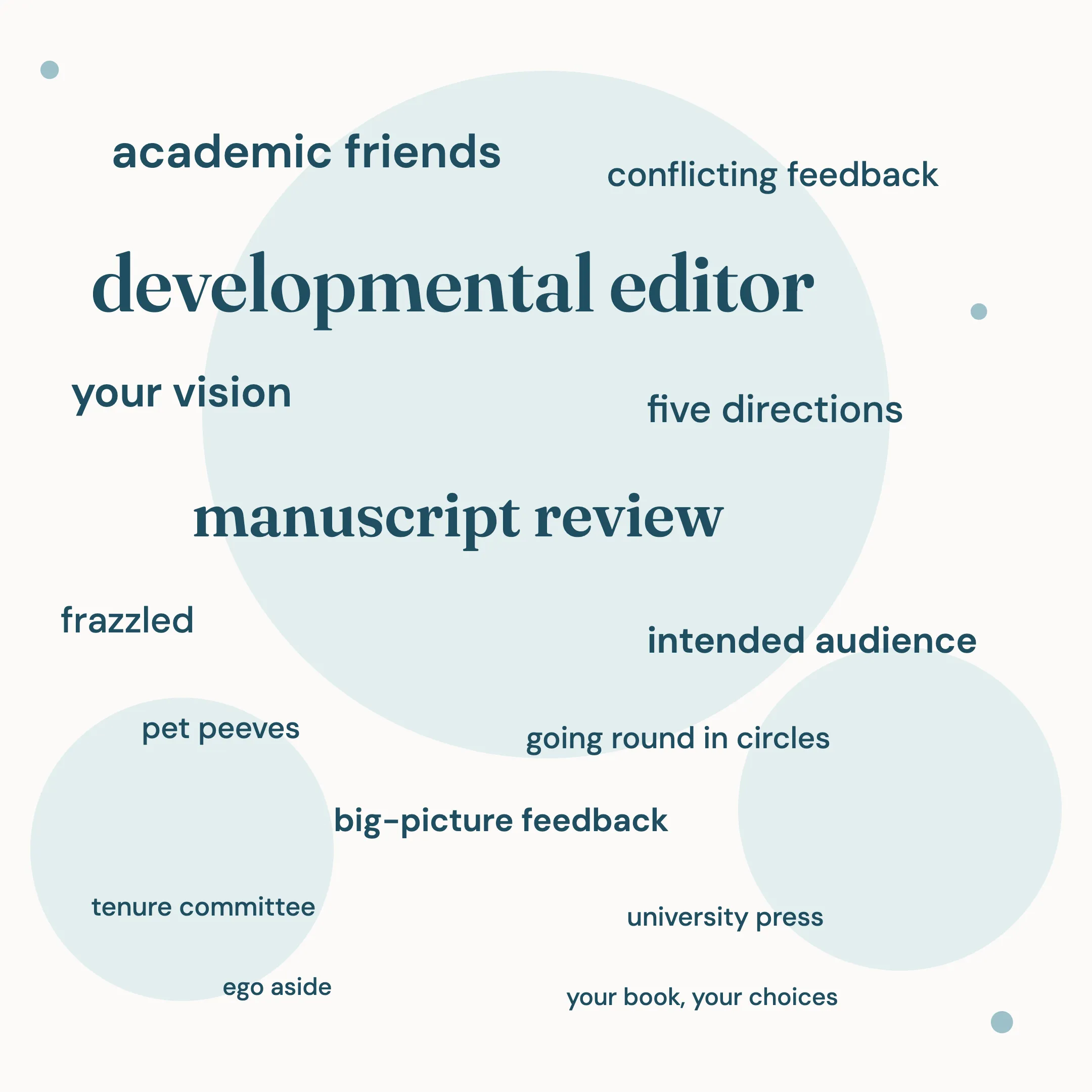
You finish the draft of a manuscript that's been years in the making. You're tired, proud, and perhaps a little nauseated, so you do what every sensible academic does and email it to a few brilliant friends. "Would you mind taking a look?" you ask, which is code for "please tell me after all this work I have something here, and also tell me how to fix the bits that don't work."
Three weeks later, the feedback arrives. Friend One thinks your argument belongs in a different field. Friend Two wants Chapter 3 gone. Friend Three loves Chapter 3 and wants two more like it. Friend Four returns a Word document bleeding tracked changes, most of them about commas. Friend Five says it's "really interesting! Loved it!" and nothing else.
Now you're at your desk, wondering whose book you're writing.
Were your friends thinking about what you were trying to do with this book? What audience you were trying to reach? They've known you've been researching and writing this manuscript for eight years––so why does it feel like they don't understand your intervention at all?
Before we go further, I want to be clear that your friends haven't given you "terrible" feedback. Most of it is probably smart, generous, and well-meant. The terrible part is how you feel afterward: confused, frazzled, and going round in circles, because there are so many voices to listen to and each one expects to be heard.
Why does feedback from friends go sideways?
Your friends are experts in their own right, and that is exactly the problem. Each of them reads your manuscript through their own training, their own research, and their own pet peeves. When a historian reads your chapter, she is reviewing the book a historian would write. When a theorist reads it, he is reviewing the book he would have written, probably with more Foucault.
Then there's the problem of the favor. Reading a full manuscript takes hours, and your friends gave you those hours for free. That creates an unspoken expectation that you will act on what they say. Ignoring a favor feels rude, so you start second-guessing choices you made for good reasons. You can't easily push back either. Asking a friend to justify a suggestion, or telling her you disagree, not only costs you something socially, but that friend has probably already moved on to reading another friend's book. Because, hello academia.
Almost nobody asks what you want the book to do. Who is it for? A intimate audience of your closest peers? Curious readers outside your field? The general public? Without that answer, every piece of advice is a vote for a different book, and you end up with five competing manuscripts.
What does a developmental editor do differently?
A major difference between an academic friend and a developmental editor is that an editor charges you for what a friend does for free. That is also the problem with free. An editor is a professional who works with you, with your interests in mind and their ego set aside. Your friend, as another scholar, will likely be colored by how they would have written the book, and will––even if they don't say it––expect you to listen.
A developmental editor starts by asking you questions. What are you trying to achieve with this text? Who do you want to reach? What does success look like for you? The feedback that follows is measured against your answers, not against the editor's taste. From the get-go, they are on your team.
From there, the editor lays out the routes you could take and what each one costs and gains you. If you want to reach a specialist audience, the theory section probably stays and might grow. If you want a broader readership, it may need to shrink and terminology throughout the manuscript might need to shift, and the editor will say what you'd gain and what you'd lose. Neither route is wrong. Each one produces a different book, and you get to choose with your eyes open.
A developmental editor also doesn't take it personally when you say no. Their value to you is perspective, not compliance. If I recommend restructuring your second half and you decide to keep it as is, I've done my job as long as you made that call knowing what it would do. Your book carries your name and your argument, and your vision for what you want to put into the world overrides my preferences.
Where do friends still belong in the process?
Keep them. Friends are great for cheering you on, for sanity-checking a claim in their specific subfield, and for reading the near-final version. Just don't ask them to be your big-picture reader. Asking five people for developmental feedback at once is how you end up with five answers and no direction.
Takeaways
Before you send your draft to anyone, write one paragraph stating what the book is for and who it's for. Give that paragraph to every reader, friend or editor, and ask them to respond to it. If you're already sitting on a pile of contradictory comments, a developmental editor can help you sort which ones serve your goals and which belong in the recycling bin.
If you're over relying on friends to give you feedback on your work that just makes you more confused, consider working with me as your developmental editor. Over a free consultation call, we'll go over what you're trying to achieve with your manuscript, who you're trying to reach, and the barriers blocking your path toward publication. Click here to read about developmental editing and get in touch.