Insights
Pro Tips

Laura Vasquez Bass, PhD
Mar 5, 2026
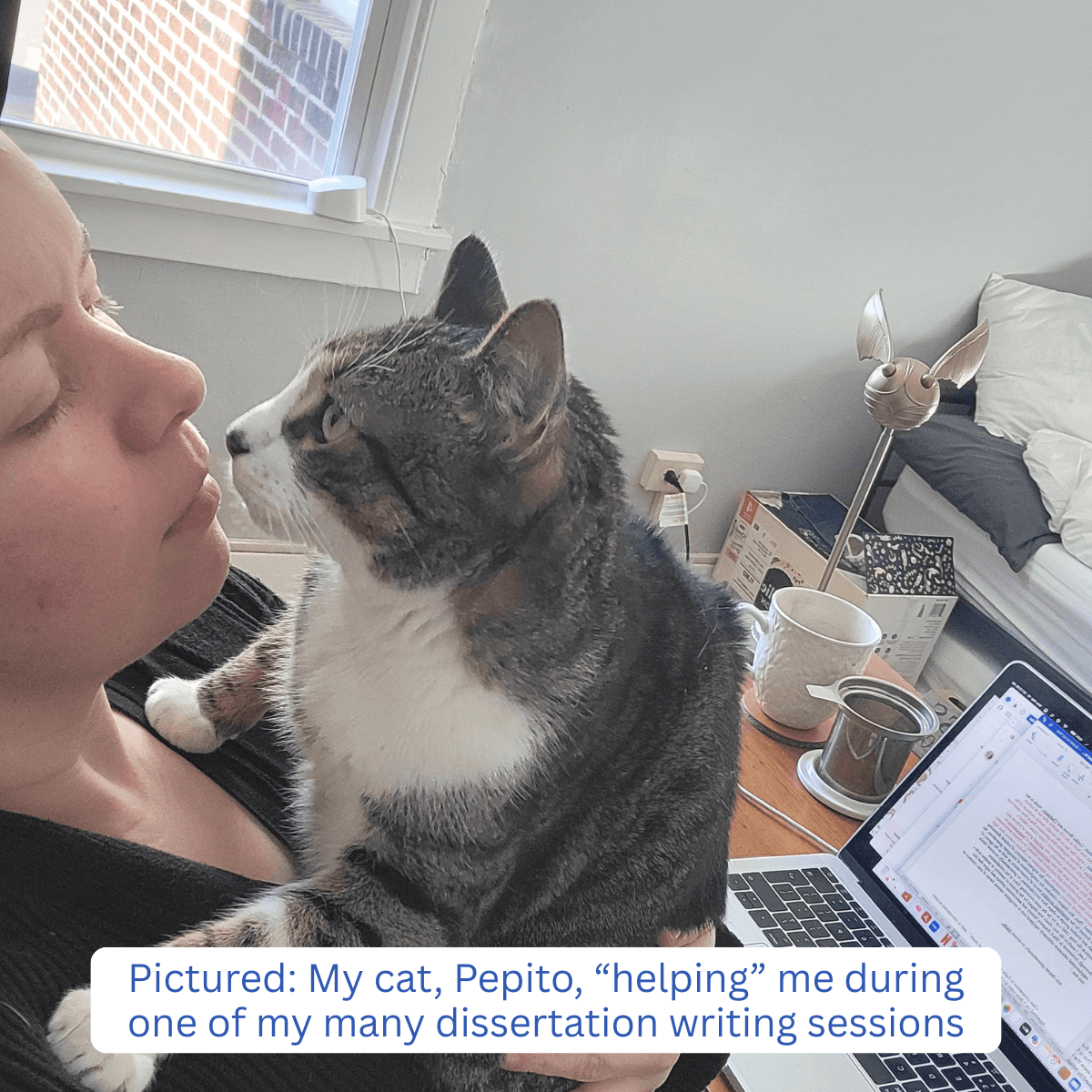
“I have the research. I just don’t know how to start writing my dissertation. I feel so lost.”
If you’ve ever found yourself staring at a blank document and then quietly Googling "how do I start my dissertation?," you are not alone.
This is one of the most common—and least talked about—stages of dissertation writing. Not the research phase. Not the defense. Not the writer's block cropping up mid-process. But rather, the beginning.
You’ve read hundreds of articles. You’ve taken meticulous notes. You’ve presented at conferences. You wrote a strong proposal that your committee accepted.
And yet when it’s time to actually begin writing your dissertation, everything feels impossibly heavy and you feel absolutely paralyzed.
Here’s what I want you to know:
First, this is SO common. Meticulously planning what you want your project to be is one thing, but bringing it into fruition to be judged by a group of researchers you admire is quite another.
Starting a dissertation comes down to igniting that initial momentum, which will carry you through the whole project.
If you’re stuck on how to start writing your dissertation and get that momentum going, here are three strategies that work—especially for high-achieving, thoughtful scholars who feel the weight of the work.
1. Begin with free-writing your motivations
Before you worry about structure, citations, or whether your dissertation's argument is making a big enough intervention, pause.
Ask yourself:
What drew me to this research?
What made me feel like an intervention was necessary?
What problem am I trying to address?
Why does this matter—to me, to my field, to the world? (If your field and the world are too scary right now, just focus on yourself).
Set a timer for 20 minutes and write without editing.
Don't worry about anything except answering these questions authentically and in your own words.
When people think about how to start a dissertation, they often assume they need a template or a perfectly structured opening paragraph. But what most scholars actually need is reconnection.
Your dissertation topic began with a moment of intellectual or emotional magnetism—for some reason it drew you in. So, naturally, the best place to start is with reconnecting to that moment and showing your audience why it matters.
Free-writing your motivations helps you access the core argument underneath the layers of literature. And very often, what you produce in this exercise becomes the conceptual backbone of your dissertation introduction.
Not word-for-word, but via that intention you started with. When you are stuck, return to why.
2. Organize your research—and reuse what you’ve already written
Many people believe they are stuck because they “haven’t started.”
In reality, they are drowning in unstructured and underutilized material.
Dissertation writing can feel overwhelming because every thread that has contributed to your topic or argument exists everywhere:
Notes in three different notebooks
Drafts in old seminar papers
Paragraphs in grant proposals
Stray reflections in random documents
Different iterations of conference papers
So here is a simple, practical intervention:
Create a separate Word document for every chapter or section of your dissertation.
Introduction.
Literature Review.
Methods.
Chapters.
Conclusion.
Every section you anticipate!
Then begin searching your computer and copy and paste every relevant resource you find in the relevant doc (it doesn't matter if it needs to be moved around later—this is normal—just use your best judgement for now).
Do not evaluate. Just collect. It will surprise you what seemingly insignificant quote or under-synthesized thought can go on to play a huge role in a given chapter or section.
Two important things happen when you do this.
First, you realize you are not starting from zero. You already know this topic; and whether you realize it or not, your dissertation work has already begun.
Second, the blank page disappears.
When you are trying to figure out how to start writing your dissertation, the problem is not lack of knowledge, or even focus, it is organization. Once your ideas are visible and contained, it becomes much easier to shape them.
Momentum builds when the page is no longer empty.
3. Do not begin with the Introduction
This one may feel counterintuitive.
But if you are frozen, stop trying to write your introduction.
The introduction feels high-stakes. It sets the tone. It frames the argument. It signals competence. Of course, it feels intimidating. In fact, I actually wrote my dissertation introduction after I'd finished all of my chapters!
So skip it.
Forget linearity.
Dissertation writing does not have to be chronological. It has to be written.
Ask yourself:
What part of this project genuinely interests me right now?
Is it a theoretical framework you love?
A data pattern that surprised you?
A methodological choice you’re proud of?
A critique you’ve been thinking about for months?
Begin there.
It does not matter if that section ultimately lives in chapter two or the conclusion. What matters is that you are writing.
When scholars agonize, “how do I start my dissertation,” they often assume there is a correct first paragraph.
I'm here to stay, there isn’t. There is only a first act of engagement. And it does not matter to the reader if that happened at the very beginning of your writing process, or the end. Actually, I'd wager that first act of engaging the reader will actually be better if it's written after you've been immersed in your project for a while.
Closing thoughts: If you’re stuck, lower the pressure
If you take nothing else from this blog, please remember:
You do not start a dissertation by proving you are capable—you start it by allowing yourself to write imperfectly.
Reconnect to why the work matters.
Gather what you have already done.
Begin where your intellectual energy already exists.
Momentum first.
Refinement later.
The blank page is scary, yes. But it is also an invitation to begin something brilliant and original and you. The blank page is an opportunity.